
How Do Dentists Decide Whether a Tooth Can Be Saved?
How Do Dentists Decide Whether a Tooth Can Be Saved?
Table of Contents
Key Takeaways
Whether a tooth can be saved depends on how much healthy structure remains, as well as the condition of the roots, gums and supporting bone.
A tooth that looks badly damaged may still be treatable if there is enough stable structure to rebuild and protect it.
Infection or nerve involvement does not always mean removal is necessary, as the overall condition of the tooth must be assessed before deciding on treatment.
Assessing a damaged tooth before further structure is lost can help clarify what treatment options remain available.
Introduction
When a tooth is badly decayed, cracked or infected, it is natural to wonder: can a tooth be saved, or has the damage gone too far?
The answer is not always clear from what you can see or feel. Some teeth may look badly broken but still have healthy roots and enough strong structure to restore. Others may appear mostly intact, yet have a deep fracture, significant infection or weakened support underneath.
When we assess a damaged tooth, we look at the full picture, not just the visible damage. This can include examining the tooth, reviewing dental X-rays, checking the gums and supporting bone, assessing how the tooth meets your bite, and considering whether it can support a restoration over time.
The goal is not to keep a tooth at any cost. It is to work out whether the tooth can be restored predictably, function comfortably and remain maintainable over time.
How Do Dentists Assess Whether a Tooth Can Be Saved?
Dentists rarely assess a severely damaged tooth based on one issue alone. We consider several factors, including how much healthy tooth remains, the condition of the roots and supporting tissues, and whether any infection or fracture can be treated. Taken together, these findings help us judge what treatment is realistically possible and whether the tooth has a reasonable long-term outlook.
Is There Enough Healthy Tooth Structure Remaining?
One of the first things we look at is how much strong, healthy tooth structure remains.
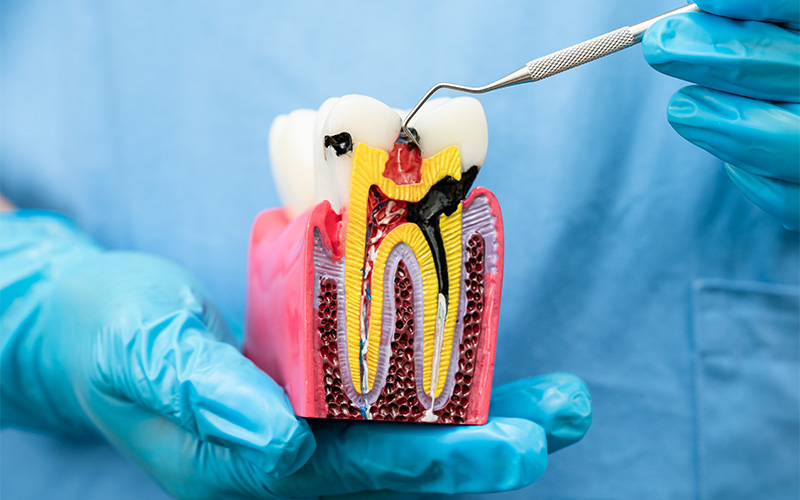
Fillings, onlays and crowns all need enough sound tooth structure to support the restoration and cope with everyday chewing. The location of that remaining tooth structure also matters. A restoration generally needs a stable band of sound tooth around the lower part of the tooth to help it withstand chewing forces. If damage extends very deeply towards or below the gumline, achieving this support may become more difficult.
For example, two molars can look similarly broken at first glance. In one case, the damage may stop above the gumline, leaving enough solid tooth to restore and protect with a dental crown. In another, decay may extend much deeper towards the root, leaving far less healthy structure to support treatment. Damage extending below the gumline does not automatically mean a tooth must be removed. In selected situations, additional procedures may make more healthy tooth structure accessible for restoration, although this depends on the root, bone support, aesthetics and overall prognosis.
That is why visible damage tells only part of the story. What matters just as much is how much usable tooth remains underneath.
Are the Root, Gums and Supporting Bone Still Stable?
The visible part of the tooth is only one piece of the picture. We also need to understand how well the tooth is supported underneath.
This usually means reviewing the roots on X-rays, checking the surrounding bone and examining the gums for signs of periodontal disease. We may also assess whether the tooth feels loose, as reduced support can affect how well it is likely to hold up over time.
A tooth may be rebuildable above the gumline but still have a limited outlook if there has been significant bone loss around the root. On the other hand, a tooth that looks badly damaged may still have intact roots and good supporting bone which can leave more options open.
We also consider how the tooth will function after restoration, including the chewing forces it will need to withstand and whether grinding or clenching is likely to place additional stress on it. Another key consideration is whether the area can be kept clean and maintained after treatment, because a restoration that cannot be adequately maintained may still have a poor long-term outlook.
Has the Damage Reached the Dental Pulp?
When decay, trauma or a cracked tooth reaches the pulp, it can sound as though extraction is the only option. In many cases, that is not necessarily true.
If the pulp and root canal system can be treated appropriately, the root is structurally suitable, and enough tooth remains for restoration, root canal treatment may allow the tooth to be retained. We assess not only whether the pulp is infected or inflamed, but also whether the tooth will still be strong enough to restore once treatment is complete.
A tooth with an abscess may be treatable with root canal treatment, but if extensive decay or fracture has already left very little restorable tooth structure, its overall prognosis may still be poor. Conversely, the presence of infection around the root does not automatically make a tooth unsalvgeable if the infection can be treated and the tooth otherwise has a reasonable endodontic, periodontal and restorative outlook.
So, the presence or extent of an infection does not determine the outcome on its own. We also consider whether the infection can be treated and whether the tooth remains suitable for restoration afterwards.
Where Does a Crack Actually Extend?
With a cracked tooth, the key question is not simply whether a crack is present, but how far it travels. We assess the apparent location and extent of the crack, together with symptoms, periodontal findings and other clinical tests.
Fine cracks may not be visible on conventional dental X-rays, and their full extent is not always possible to determine before treatment. Symptoms such as pain when biting, lingering sensitivity or changes around the gum can also help us understand how the tooth may be affected.
A more limited crack may sometimes be protected with a suitable restoration. If the pulp is affected, root canal treatment may also be part of the treatment plan. However, when a fracture extends deeply below the gumline or runs vertically through the root, restoring the tooth may become much less predictable.
This is why two cracked teeth can have very different outcomes. The location, depth and direction of the fracture all influence whether the tooth can still be restored.
When Might Extraction Be the More Appropriate Option?
In some cases, keeping a tooth may no longer offer a reliable long-term outcome.
Extraction may be considered when decay has left too little healthy tooth structure to restore, when a fracture extends deep below the gumline or vertically through the root, when severe bone loss has weakened the tooth’s support, when an infection cannot be adequately resolved, or when the tooth cannot be restored in a way that can be adequately cleaned and maintained.
We also look at what the tooth is likely to be like after treatment. A tooth may be technically treatable, but that does not automatically mean treatment is the best option. We also consider the amount and complexity of treatment required, the expected prognosis, whether the tooth can be maintained afterwards and what alternatives are available.
This is where clinical judgement matters. The decision is not simply about whether treatment is possible, but whether the tooth is likely to remain stable, functional and maintainable afterwards.
Why Does Timing Affect the Treatment Options Available?
Dental problems are often easier to manage while the damage is still limited.
As decay progresses and more tooth structure is lost, restorative treatment may become more extensive. If the pulp eventually becomes significantly inflamed or infected, additional treatment may also be needed. Some cracks may propagate or weaken additional tooth structure over time, although their behaviour can vary.
When we assess a problem earlier, there is often more healthy tooth structure left to work with. That can give us more options for preserving the tooth and may reduce the amount of treatment needed.
Prompt assessment is especially important after trauma, as it can help identify injuries to the tooth, pulp or supporting tissues and determine whether treatment or monitoring is required.
Assessment cannot guarantee that a damaged tooth can be retained, but identifying the problem before further tooth structure or support is lost may leave a wider range of management options available.
What Happens If a Tooth Cannot Be Saved?
If extraction is the more appropriate option, we then look at how the missing tooth may affect the rest of your mouth and what replacement options are worth considering.
We assess the neighbouring teeth, available bone, gum condition, bite and the position of the missing tooth before discussing suitable tooth replacement options. Depending on the situation, these may include a bridge, removable denture or dental implant.
The most suitable option varies from person to person. An implant may be one option considered when the local bone and gum conditions are suitable and the patient’s wider health and treatment circumstances support implant treatment. A bridge or removable denture may be more appropriate in other situations.
We do not look at extraction as an isolated decision. We also consider how the space may affect function, neighbouring teeth and the wider treatment plan.
The Real Question Is Not Just “Can It Be Saved?”
When patients ask whether a tooth can be saved, the answer depends on much more than how the damage looks from the outside. We consider how much healthy tooth remains, the condition of the roots, gums and supporting bone, whether infection is present, how far any fracture extends, and how the tooth functions within the bite.
At Canaan Dental Surgery, we assess these factors together before recommending whether to restore or remove a damaged tooth. We look at what is happening beneath the surface, what treatment would be needed, and whether the tooth is likely to remain stable and functional afterwards.
If you have a painful, broken, infected or badly decayed tooth, contact Canaan Dental Surgery to arrange an assessment and discuss the options for your individual situation.
FAQs About Saving a Damaged Tooth
Is it always better to save a natural tooth than have it extracted?
When a natural tooth can be predictably restored and maintained, preservation is often worth considering. However, saving a tooth is not always the best option if its restorative, periodontal or endodontic prognosis is poor. In those situations, extraction and management of the resulting space may provide a more appropriate long-term plan. The decision should consider both the expected outcome of saving the tooth and the alternatives available.
Can a badly broken tooth still be saved?
Sometimes. The decision depends on where the fracture extends, how much sound tooth remains, the condition of the pulp and roots, and the health of the supporting gums and bone. A tooth that looks extensively broken may still be restorable if sufficient stable structure remains, while a smaller-looking fracture that extends deeply into the root may have a much poorer prognosis.
Clinical examination and dental X-rays provide important information, although fine cracks may not always be visible on X-rays.
How do dentists know if a tooth needs a root canal or extraction?
Depending on the situation, your dentist may use pulp sensibility tests, bite or percussion tests, periodontal examination and dental X-rays.
Root canal treatment may be considered when the pulp is irreversibly inflamed or infected and the tooth remains restorable. Extraction may be considered when the tooth has a poor overall prognosis because of factors such as insufficient remaining structure, an unfavourable fracture, severe loss of support or another problem that cannot be predictably managed.
Does an abscess mean the tooth has to be extracted?
No. An abscess does not automatically mean a tooth has to be removed. In some cases, root canal treatment can address infection originating from inside the tooth if the tooth is otherwise restorable and has adequate support. Whether the tooth can be retained depends on factors such as the remaining tooth structure, root condition, periodontal support and whether the infection can be managed predictably.
Can a tooth be saved if the damage goes below the gumline?
Sometimes. Damage extending below the gumline can make restoration more difficult because the dentist needs enough accessible, stable tooth structure to support a restoration and allow the area to be maintained. In selected cases, additional procedures may make restoration possible. However, if damage extends too deeply into the root or would compromise the tooth’s support, extraction may be the more predictable option.

