
Composite Artistry at IDEM 2026: Dr Chong Shares Clinical Insights on Restoring Posterior Teeth
Composite Artistry at IDEM 2026: Dr Chong Shares Clinical Insights on Restoring Posterior Teeth
Composite Artistry at IDEM 2026:
Dr Chong Shares Clinical Insights
on Restoring Posterior Teeth
The IDEM 2026, held at Marina Bay Sands, brought together dental professionals, educators, and innovators from across the region to exchange knowledge and explore the latest developments in dentistry.
We are proud to share that our Clinical Director, Dr Isaac Chong, was invited to conduct a workshop on 19 April 2026 during the event. His presentation, titled “Composite Artistry, Restoring Posterior Teeth that Mimics Natural Dentition in Both Aesthetics and Occlusal Wear,” explored the science and clinical techniques behind achieving natural-looking and durable posterior composite restorations.
Acknowledging the Team Behind the Work
Dr Chong began the session with a brief but meaningful acknowledgement of the people who make his clinical and educational work possible. He expressed his gratitude to both his family and the clinic team for their continued support, noting that clinical excellence and teaching are never individual efforts.
Their support allows him the time and focus required to refine techniques, document clinical cases, and share knowledge with fellow dental professionals. It was a reminder that behind every lecture and every clinical advancement is a strong support system that makes it possible.

The Science Behind Posterior Composite Restorations
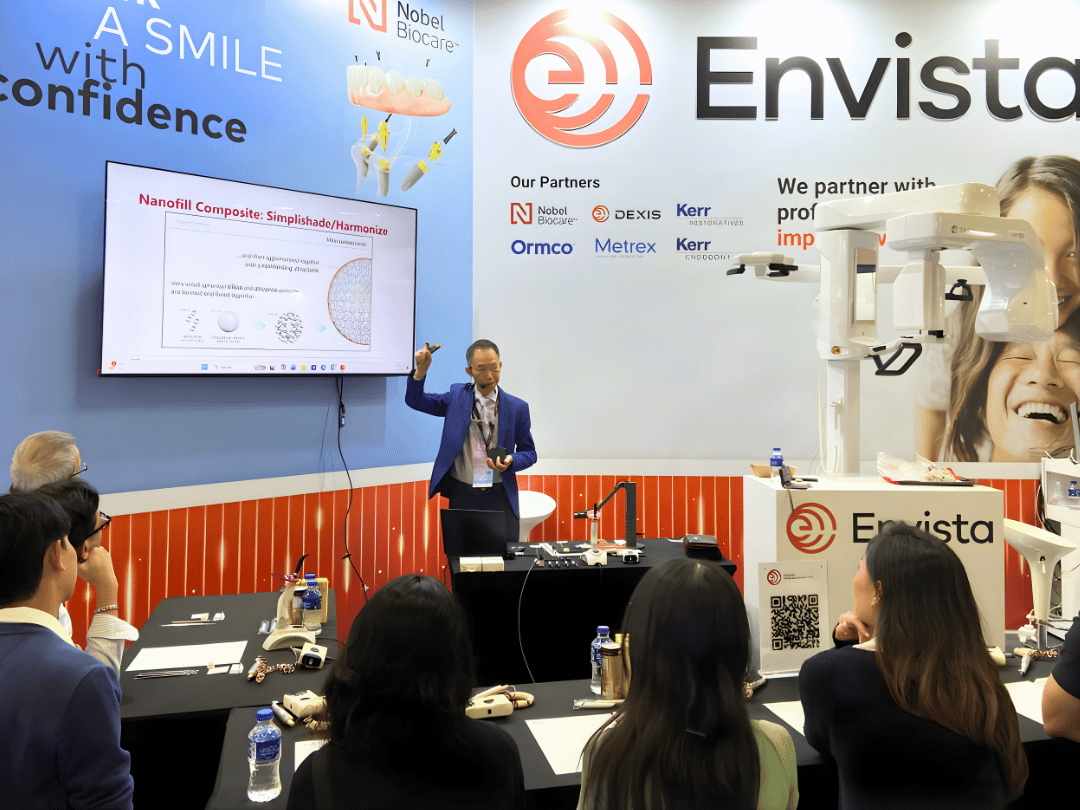
The lecture first focused on the material science of modern composite restorative systems. Posterior teeth experience significant functional load during chewing, which means restorations must be able to withstand occlusal forces while maintaining structural integrity and aesthetics.
Dr Chong discussed how advancements in composite materials have allowed clinicians to achieve restorations that more closely mimic the mechanical and optical properties of natural teeth. Modern composite systems are designed to provide improved handling, strength, and shade integration, allowing dentists to restore teeth with greater efficiency and predictability.
The discussion highlighted several important considerations for clinicians, including:
- The evolution of composite materials suitable for load-bearing posterior restorations
- Handling characteristics that influence adaptation and sculpting
- Achieving natural aesthetics while maintaining functional durability
- Simplifying restorative workflows without compromising outcomes
For many clinicians, the goal is increasingly biomimetic dentistry—restoring teeth in a way that replicates natural structure, function, and appearance as closely as possible.
Clinical Techniques for Natural Posterior Anatomy:
Learning Through Real Clinical Cases
Building on the scientific foundation, Dr Chong then shared his clinical workflow for posterior composite placement.
Participants were guided through practical techniques that help clinicians achieve restorations that function well within the patient’s bite while maintaining natural tooth anatomy. These included considerations such as isolation, incremental composite placement, and sculpting anatomical features such as cusps, ridges, and grooves.
Attention to these details plays an important role in ensuring that restorations integrate seamlessly with the surrounding dentition and maintain proper occlusal function over time.
The session emphasised that successful posterior restorations are not simply about filling a cavity— they require thoughtful reconstruction of tooth anatomy so that the restoration behaves similarly to natural enamel and dentine under functional load.

To illustrate the concepts discussed, Dr Chong presented several clinical cases from his own practice. These cases demonstrated how the principles of composite artistry can be applied in everyday restorative dentistry.
Participants were able to see how posterior teeth with significant structural loss can be restored with composite materials while recreating natural occlusal morphology and maintaining aesthetic harmony with adjacent teeth.
By sharing real treatment workflows and clinical outcomes, the lecture provided practical insights that clinicians could readily translate into their own practices.
Hands-On Application
Following the lecture component, the workshop transitioned into a hands-on session, where participants had the opportunity to apply the techniques discussed earlier.
Hands-on learning plays an essential role in continuing dental education. It allows clinicians to better understand material handling, refine sculpting techniques, and develop confidence in recreating natural tooth anatomy.
Through guided practice, participants were able to explore methods of shaping composite restorations to achieve both functional and aesthetic outcomes.

Continuing the Learning Beyond the Workshop
To support ongoing learning, Dr Chong also shared QR codes linking to instructional videos hosted on our clinic website. These videos demonstrate key restorative techniques, including Class IV and Class II composite restorations, allowing participants to revisit the methods demonstrated during the workshop.
Providing access to these resources ensures that clinicians can continue refining their skills even after the event, reinforcing the practical knowledge gained during the session.
Advancing Dentistry Through Shared Knowledge


Events such as IDEM 2026 play an important role in advancing the dental profession. By bringing clinicians together to share experiences, techniques, and research, these gatherings contribute to improved clinical outcomes and better patient care.
We are honoured that Dr Chong had the opportunity to share his approach to posterior composite restorations with colleagues from across the region. It reflects our clinic’s ongoing commitment to clinical excellence, continuing education, and evidence-based dentistry.
Through initiatives like these, we continue to learn, grow, and contribute to the wider dental community—while ensuring that the care we provide to our patients remains grounded in both scientific understanding and refined clinical experience.

